

How Zocdoc Evolved its Business Model to Unlock Exponential Growth with Network Effects
Zocdoc’s multi-year effort to shift from a SaaS model to a true platform model reveals several best practices and strategies that other digital health leaders can learn from to drive exponential growth.
Zocdoc, founded in 2007, began as one of the first online healthcare marketplaces, connecting patients with doctors through real-time appointment booking. Originally structured as a flat-fee subscription business, Zocdoc’s model was predictable and easy to manage. However, over time, cracks in the model exposed its limitations in value creation and capture, scalability and customer retention.
In 2018, Zocdoc transitioned to a platform business model—charging providers per new patient booking—and their business took off.
Why Zocdoc Needed to Change
Zocdoc’s original subscription model charged doctors a flat annual fee for access to the platform. This simplicity had advantages. It was easy to administer and sell, generated predictable revenue and posed no regulatory concerns.
However, Zocdoc’s SaaS business model began to reveal its limitation:
Inequitable Value Capture: High-demand providers (e.g., dermatologists in urban centers) got far more bookings, making the subscription fee a bargain, while low-demand providers found it too expensive and churned.
Stagnant Growth: Marketing spend failed to generate equitable value across providers as new patient acquisition was largely driven to already popular doctors.
Provider Churn: Many lower demand doctors, unsure of ROI, exited the platform—especially in rural markets and lower volume specialties.
Zocdoc’s marketplace dynamics needed a more flexible, value-aligned business model.

Summit Health Advisors’ Enterprise Network Effects Blueprint is a step-by-step manual for launching a platform business in healthcare.
Moving Toward a Platform Model
Zocdoc sought to shift to a transactional model, common in other industries (e.g., Amazon’s take rates, Uber's ride fees). In healthcare, however, this introduces significant regulatory complexity, particularly around anti-kickback laws.
Key Challenges:
Anti-Kickback Regulations: A transactional model risked violating federal statutes that prohibit payment for patient referrals. Zocdoc faced a multiyear process with HHS to secure clarity and permission.
Technical Complexity: Any monetization change required ensuring that results remained patient-directed, not provider-promoted. This necessitated transparency features like sponsored listings with clear labeling.
Provider Resistance: High-performing doctors paying low flat fees resisted price increases; transitioning them to variable pricing required education on ROI and the lifetime value (LTV) of a new patient.
State-based Needs: Zocdoc had to adapt its model to each state’s fair market value rules and specialty-based pricing, necessitating bespoke legal and pricing strategies.
Zocdoc’s Platform Transition Strategy
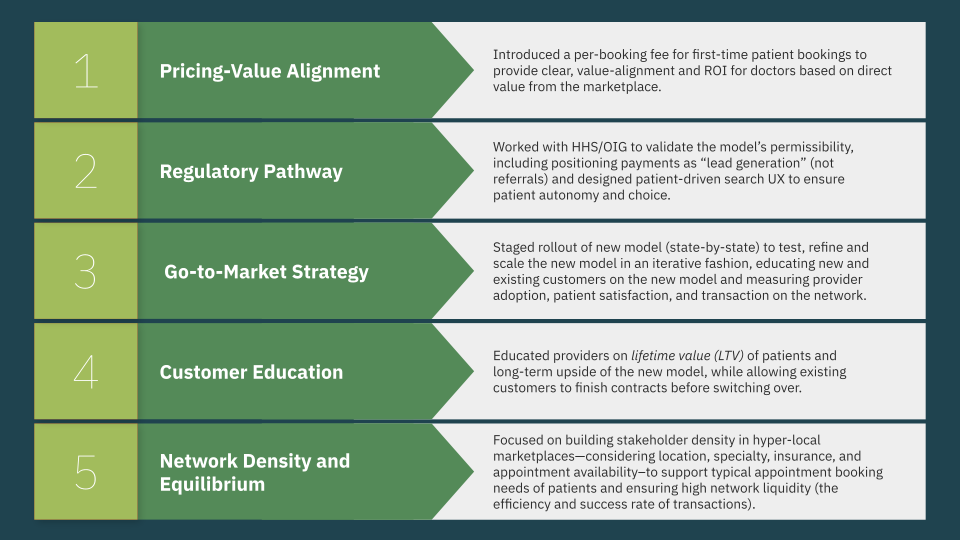
Lessons for Healthcare Companies Making the Platform Leap
Value Alignment Is Crucial: Flat SaaS fees may seem easier, but they rarely reflect actual value delivered. A transactional model that aligns revenue with provider outcomes improves retention and fairness.
Patience and Staged Execution Are Key: Don't flip the switch overnight. Test in micro-markets, adapt based on feedback, and educate stakeholders.
Think Hyper-Local: Healthcare isn’t like rideshare or e-commerce—patients won’t travel far. Build dense, localized supply and match it with precise patient demand signals.
Infrastructure is a Moat: Zocdoc spent 17 years building EHR integrations, appointment logic, and regulatory pathways. These investments create long-term defensibility and network effects.
Regulatory Planning Is Not Optional: Transactional models must navigate anti-kickback and fair market value laws. Seek legal clarity early and review past opinions is critical for compliance and long-term success.
Zocdoc Today
After a nearly two-decade journey, business model transformation has helped Zocdoc become one of the greatest marketplace success stories in healthcare, with over 200,000 providers across 250 specialties on the network.